
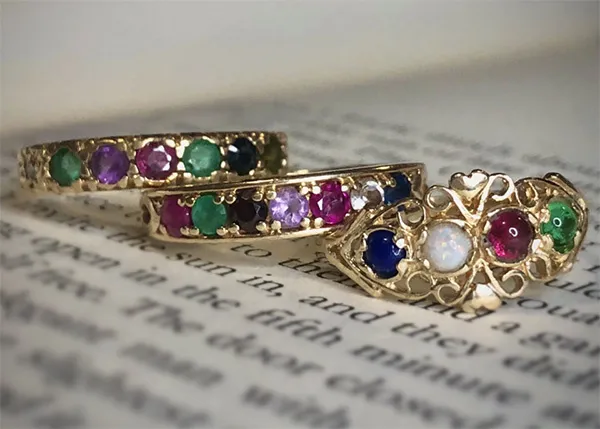
Long before couples could send heart emojis or whispered text messages, romantics expressed their deepest feelings with colorful gemstone rings that concealed affectionate messages only the giver and recipient understood. More than 200 years ago, famed French jeweler Jean-Baptiste Mellerio designed an extraordinary ring that spelled out the phrase "J'adore" — French for "I love." The secret message was revealed by the first letter of each gemstone set into the ring: Jacinth (an orange-red variety of zircon), Amethyst, Diamond, Opal, Ruby and Emerald.

The romantic creation launched a jewelry trend that would captivate Europe and give rise to one of history's most sentimental styles: acrostic jewelry.
Developed in France during the early 19th century by the storied house of Mellerio, acrostic jewelry transformed gemstones into a secret language. By arranging gems so their initials formed words, jewelers created rings, bracelets and brooches that concealed heartfelt messages in plain sight.
The concept quickly caught the attention of Napoleon Bonaparte, who was so enchanted by the idea that he commissioned acrostic pieces for members of his family. Soon, aristocrats across Europe were exchanging jewelry that carried coded declarations of affection.
The trend found especially fertile ground in England during the Georgian and Victorian eras. At the time, society operated under strict rules of etiquette. Open displays of intense emotion or romantic passion were often frowned upon, particularly in mixed company. Acrostic jewelry offered a wonderfully discreet alternative.
A suitor could present a ring whose meaning was known only to the giver and recipient. To everyone else, it was simply a beautiful piece of jewelry. To the wearer, it was a private love letter worn proudly on the finger.
Among the most popular messages was DEAREST, spelled with Diamond, Emerald, Amethyst, Ruby, Emerald, Sapphire and Topaz. Another favorite was REGARD, represented by Ruby, Emerald, Garnet, Amethyst, Ruby and Diamond.
Shorter words carried equally powerful meanings. ADORE was created with Amethyst, Diamond, Opal, Ruby and Emerald, while LOVE was spelled using Lapis, Opal, Vermeil — an antique term sometimes used for garnet — and Emerald.
The rings themselves were often exquisitely crafted. Some featured orderly rows of gemstones, while others scattered the gems asymmetrically, adding an extra layer of mystery for anyone attempting to decode the message.
Today, acrostic jewelry is enjoying a resurgence. Modern consumers have developed a renewed appreciation for pieces that are deeply personal, rich in symbolism and inspired by antique styles. And jewelers are responding with multi-stone design options that tell stories unique to the wearer.
The appeal is easy to understand. In an era dominated by texts and emojis, there's something wonderfully romantic about expressing your feelings the old-fashioned way — with a secret message hidden among sparkling gemstones.
Credits: Photo of acrostic rings by Jlblackmore, CC BY-SA 4.0, via Wikimedia Commons.
